Choosing Damask Labels is not just a matter of picking the richest pattern. Global buyers must weigh texture, legibility, durability, customization, and supplier consistency. A label may look elegant under showroom lights, then lose detail when woven small. That matters.
William Morris, the British designer and textile artist, offered a useful principle: “Have nothing in your houses that you do not know to be useful, or believe to be beautiful.” His words were not about labels, but they frame the choice well. A strong damask design should look refined and serve its purpose. Buyers should inspect lettering, edge finish, color contrast, and how the label feels against the garment. Ask for a physical sample. Check how fine details appear at actual size.
This guide compares seven Damask Labels options for international sourcing decisions. It considers design flexibility, material feel, production suitability, and practical points to confirm with suppliers. No single option fits every brand. A small boutique may value intricate detail; a large apparel program may prioritize repeatable quality and clear specifications. There is room for doubt. Catalog photos rarely show every limitation, and supplier descriptions can leave questions unanswered. Use the shortlist as a starting point, then confirm dimensions, artwork, lead times, and sample approval directly. A careful check can prevent an attractive label from becoming an awkward surprise.
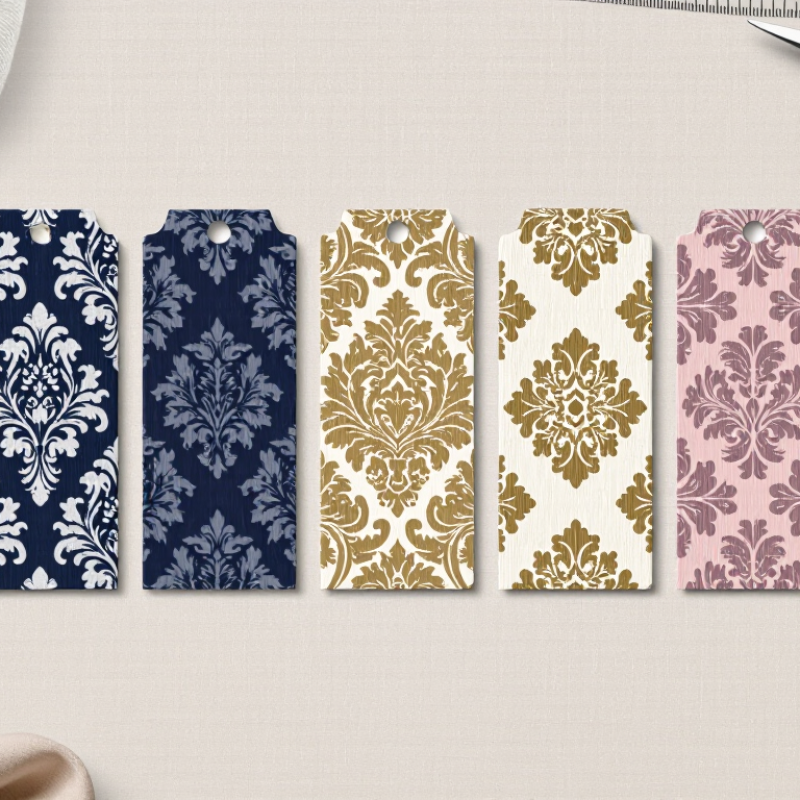
Damask labels are made by weaving fine yarns into a dense surface, rather than printing a design onto fabric. The weave creates contrast between glossy and matte areas, giving small lettering and symbols a crisp, tactile look. They are common on garments, bags, and home textiles, where a label may need to carry a size, care detail, or maker information. They suit products that benefit from a refined finish. Not every design needs one.
The scale of textile production helps explain why durable identification matters. Textile Exchange’s 2024 Materials Market Report estimated that global fiber production reached 124 million tonnes in 2023. This figure describes the fiber sector, not damask-label demand, but it shows the vast range of products that labels may accompany. For buyers, useful checks include legibility at the finished label size, edge comfort against skin, and color contrast under ordinary indoor light. A dense weave can preserve fine detail, yet very small text may still blur. Test a sample.
Choose the weave and backing for the product’s actual use. A soft label inside a lightweight shirt needs a different feel from one attached to a structured bag. Confirm wash performance and abrasion resistance with samples and relevant care tests. One practical flaw: teams sometimes approve a label from a screen image alone. That can hide stiffness, sheen, or hard edges. I would review a physical sample before approving production.
Typical applications for damask woven labels, compared by their suitability for fine-detail readability and resistance to everyday wear.
How to read this chart: Ratings use a qualitative 1–5 suitability scale, not market-share or test data. They reflect typical application needs; actual performance depends on yarn, weave, construction, and care conditions.
When evaluating damask label suppliers, inspect more than a polished sample. Ask for a production sample made with the same yarn, loom settings, and finishing process. Look closely at fine lettering, satin sheen, and edges where threads may loosen. Small details matter.
Confirm color consistency across batches, and request wash and rub-test results for the intended garment use. A label that looks rich under showroom lights may fade or feel stiff after laundering. Check backing options, cutting accuracy, and whether folded edges sit flat inside a collar. No sample tells everything.
Reliable suppliers explain their quality checks, tolerances, and corrective steps in plain language. Compare sample approval time, realistic production lead times, order flexibility, and shipping updates—not only unit price. Ask how they track materials and reproduce approved colors for repeat orders. A supplier’s response to a small defect can reveal more than a flawless sales pitch. Even careful checks cannot prevent every variation, so document acceptable limits before production.
Global buyers need more than a sharp woven logo. Damask labels must keep fine lettering legible, edges neat, and colors consistent across repeat orders. A practical shortlist can cover seven supplier types: vertically integrated mills, jacquard specialists, recycled-yarn producers, low-minimum converters, nearshore makers, digital sampling studios, and export-focused manufacturers. These are sourcing profiles, not interchangeable companies.
Textile Exchange’s Materials Market Report 2024 estimates global fiber production reached 124 million tonnes in 2023.
That scale makes fiber origin and material documentation useful questions for label buyers, even when order volumes are small. Ask suppliers for yarn specifications, wash-test results, color references, and sample approval records. Check how they control loom settings and inspect fine text; a tiny letter can blur quickly. No supplier wins every test.
The WTO’s Global Trade Outlook and Statistics 2025 reports that merchandise trade volume rose 2.9% in 2024, after falling 1.1% in 2023.
For buyers, cross-border purchasing still calls for clear lead times, packing details, and contingency plans. Request a physical sample before confirming bulk production. Compare quotes by usable-label yield, not unit price alone. One weakness remains: supplier questionnaires rarely prove factory practice without checks. Ask for evidence, then verify it.
For global buyers, seven useful damask-label choices are standard weave, high-definition weave, recycled-polyester yarn, cotton-blend yarn, satin-finish weave, center-fold, and end-fold. These options differ in hand feel, detail, and construction—not just appearance. Textile Exchange’s Materials Market Report 2024 estimates that global fiber production reached 124 million tonnes in 2023, with polyester making up 57%. That scale helps explain polyester’s availability, but it does not prove a supplier’s recycled-content claim. Ask for supporting documentation.
Customization affects both legibility and cost. Fine lettering, small care symbols, dense artwork, and multiple yarn colors need a test sample before a large order. Standard damask often suits bold logos and simpler text; high-definition versions can preserve finer detail, though tiny type may still blur. Fold style should match the garment seam: a center-fold label sits neatly inside, while an end-fold label leaves both ends available for stitching. Worth checking.
Quality checks should include edge finishing, color consistency, text clarity, and wash performance on the intended fabric. Request a physical sample and test it after laundering; a digital proof cannot reveal a scratchy edge. Pricing usually depends on order quantity, dimensions, color count, finishing, and setup requirements. Larger runs may lower unit costs, while frequent artwork changes can add expense. I would compare landed quotes, not unit prices alone, and confirm what each quote excludes. Some details are easy to overlook.
7 Best Damask Labels for Global Buyers
How to Select and Source the Right Damask Labels
Choosing a damask label starts with its job: showing a size, care detail, or garment identity without distracting from the product. Check the artwork at its actual label size. Fine lettering can blur when woven, especially on a narrow label. Ask suppliers for a physical sample, then inspect the reverse, edges, and color under daylight. Small details matter.
Material and capacity deserve equal attention. Textile Exchange’s Materials Market Report 2024 estimates that global fiber production reached 124 million tonnes in 2023. That scale makes clear, verifiable material information useful when comparing suppliers. Request fiber details, production location, minimum order quantity, lead time, and applicable test records. Confirm the fold, finished dimensions, attachment method, and performance after washing. A digital proof helps, but it cannot show how a label feels against skin. That is an easy point to overlook.
Tips: Send the same artwork and specifications to each shortlisted supplier. Compare samples for readability, softness, color consistency, and fraying after a wash test suited to the garment. Keep one approved sample as your reference. Ask what happens if bulk production differs from it. Answers may vary; document them before placing an order.
| Damask Label Option | Typical Construction | Best Suited For | Key Benefits | What to Confirm When Sourcing |
|---|---|---|---|---|
| Standard Damask | Jacquard-woven label, commonly made with polyester yarns. | Apparel, bags, and other products needing a durable brand or size label. | Woven lettering and motifs are part of the fabric structure; suitable for many everyday label designs. | Request the finished dimensions, artwork proof, yarn colors, fold or cut style, and a production sample. |
| High-Definition Damask | Damask woven with finer yarns and a tighter construction, subject to the supplier’s equipment and capabilities. | Small lettering, detailed graphics, and designs with fine lines. | Can reproduce finer design details than a coarser weave. | Check the minimum readable text size and line thickness on a woven sample; artwork may need simplification. |
| Recycled-Polyester Damask | Damask woven using recycled polyester yarn; recycled content and documentation vary by supplier. | Buyers with recycled-material specifications or documented material targets. | Offers a recycled-yarn option while retaining a woven-label format. | Specify the required recycled-content percentage and request relevant transaction or certification documentation. Do not rely on a material claim alone. |
| Soft-Finish Damask | Damask label made with a softer yarn, finish, or edge treatment, depending on the construction offered. | Neck labels and products where a less abrasive label feel is important. | May improve comfort against skin compared with a firmer label construction. | Assess the hand feel and edge comfort by testing a sewn-in sample; softness can vary with yarn, weave, and finishing. |
| Center-Fold Damask | A woven label folded at the center, leaving two sides available for sewing into a seam. | Neck or side-seam labels designed to show information on both faces. | Provides a neat, sewn-in finish with a front and reverse side. | Confirm the finished visible area, fold position, seam allowance, and whether both sides need woven content. |
| End-Fold Damask | The left and right ends are folded inward to create sewing tabs. | Labels applied flat to a garment or accessory surface. | Folded ends can help cover cut edges at the attachment points. | Specify finished width and height, fold depth, orientation, and placement so the usable design area is clear. |
| Straight-Cut Damask | A flat label cut to size; the cut-edge treatment depends on the weaving and finishing method. | Labels sewn along one or more edges, such as hem, care, or product-information labels. | Simple, flexible format that can be produced in a range of shapes and sizes. | Ask how cut edges are finished, review edge comfort and fraying on a sample, and confirm the sewing margin. |
Sourcing note: Request a pre-production sample and confirm tolerances, packing, lead time, and applicable labeling requirements for each destination market. Legal textile-labeling rules vary by market and product type.